
The Lens of Innovation in Packaging Engineering
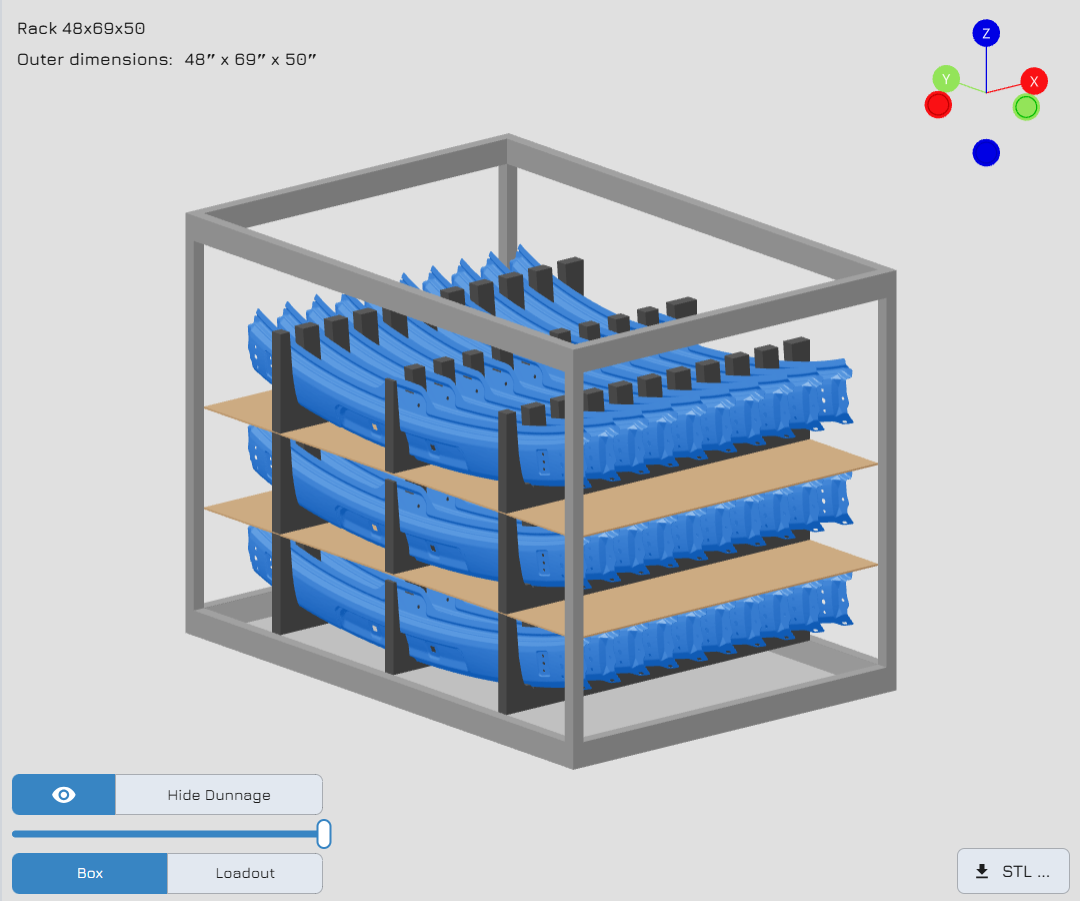
Dunnage Preview using Pack Studio™ to find True Landed Cost.
Part 1: Make vs. Buy - The Piece-Price Trap Finding Landed Cost
Welcome to Packaging Perspective, where I take learnings from the manufacturing industry and distill them into succinct ideas, actionable steps, and explore technologies that could solve them now and in the future.
In the automotive industry, the launch of a new vehicle platform is a monumental undertaking. I don’t think it would be debated that it is actually one of the most complex coordinated human efforts that happen on our planet – and stands shoulder to shoulder with mega engineering projects and new commercial aircraft launches. It creates and destroys businesses, reroutes supply chains and takes a massive amount of human capital to execute properly.
Amongst that huge amount of human capital are the procurement, supply chain and packaging folks.. Diligently toiling away and trying to figure out how every single individual component is going to be bought, protected, transported and stored for assembly onto the final vehicle. The up-front planning of which is it’s own herculean effort.
In these operations one of the key areas of investigation is, of course, location, location, location. The more miles a component has to travel, the more inventory is in “the system”, the more the logistics costs are, the more packaging protection the part needs, etc. The only problem with this is it isn’t easy to estimate, and the wonderful people in purchasing don’t have access to it unless they ask. From a purchasing analysts' perspective, they have two or ten potential suppliers who are bidding on the business for a particular part, and all they see is the cost of the individual component – A.K.A. The “piece price”. When staring at those options, its very easy to say “just choose the lowest cost and let’s move on to the next widget. We have 400 more to get through”.
However, this is a massive trap. I heave seen so many scenarios where a supplier was selected because “they were 12 cents cheaper, saving us $42,000 per year”. But what they don’t see, is the $0.80 additional in logistics, the $0.42 in packaging, the $0.08 in additional warehousing, the $1.08 in scrap/quality problems. And all of a sudden, the $42k savings the company projected, turns into a $791,000 sink hole.
The reason companies don’t enforce the make vs buy review for every major part, is it takes too much effort and guesswork to properly plan for every potential supplier and potential location. On top of that, companies’ ability to properly “should-cost” these scenarios is either non-existent, or based on some overly simplistic 12-year old excel someone built once. The only way to truly project the costs is to start from part and packaging, which dictates space requirements and from which, everything else can be properly estimated. If I am able to figure out how many parts fit in a box and on a pallet, I can now much more accurately predict my logistics, packaging, warehousing, labor, scrap, etc.
Now the only question is, how do you do it quickly?
That is why we developed Pack Studio™.
The automated way to think in systems and determine the end-to-end cost of your part. Ideally every part is analyzed in this way.
Pack Studio uses market pricing of packaging material to accurately cost out boxes and some types of dunnage (protective material inside the box). From that, you can estimate logistics and pallet costs to achieve a total landed cost of piece price AND supply chain. Being able to do this in a repeatable, accurate way is what Pack Studio is capable of.
Stay sharp,
Scott Huddas
Chief Packaging Strategist & Head of Business Development
